LED Dog Collar vs Harness: Why Vets Recommend Harnesses (+ Top 5 Picks 2026) | BestValueChoiceSkip to main content
Advertiser Disclosure: BestValueChoice.com is an independent review site funded by referral fees. We may receive compensation when you click on links and make purchases through our site — this comes at no additional cost to you. Our rankings and reviews are based on our own testing methodology and editorial judgment, and are not influenced by payments from advertisers. While we strive to include a wide range of products in our reviews, we cannot cover every option available. We encourage you to conduct your own research to find the product that best fits your needs.
Updated March 2026
LED Dog Collar vs Harness: Why Harnesses Are Safer (+ Our Top 5 Picks)
By Emily Rosen
Consumer Products Analyst · 6+ years reviewing everyday essentials
LED Dog Collar or LED Harness — Which One Is Actually Safer?
If you searched for an LED dog collar, you already know the problem: your dog is nearly invisible on evening walks, and that's dangerous. You're right to look for a solution. But after spending 6 weeks testing nighttime dog gear, we found that the type of product you choose matters just as much as the LED brightness.
Here's the short version: collars and harnesses look like they do the same job, but they don't. The difference comes down to two things — where the light goes and where the force goes.
The Medical Case Against Collars (For Dogs That Pull)
A collar puts all leash tension on a 2-inch band around your dog's neck — directly on top of the trachea, thyroid gland, and cervical spine. For a dog that pulls (and according to a 2020 survey by the Journal of Veterinary Behavior, over 80% of dog owners report leash-pulling), that's not a minor detail.
What the Research Shows
• A study in Vet Record found that collar pressure can raise intraocular pressure by up to 85% in dogs — a serious concern for breeds prone to glaucoma (Pugs, Shih Tzus, Cocker Spaniels).
•Tracheal collapse is one of the most common respiratory conditions in small breeds. The ACVS notes that chronic external pressure on the trachea is a contributing factor — and collars are the primary external pressure source on a leashed dog.
• Sudden collar jerks can cause cervical vertebrae damage, nerve compression, and soft tissue injuries. A 2006 study in JAVMA linked collar pressure to neck injuries in dogs that lunge or are restrained quickly.
A harness routes that same force across the chest and ribcage — a much larger area with dense muscle and no exposed organs. It's the difference between catching yourself with your neck versus catching yourself with your torso. There's a reason every working dog, police dog, and service dog wears a harness, not a collar.
We Tested Both — Here's What Drivers Actually See
Safety aside, we also ran a direct visibility comparison. We put an LED collar and an LED harness on the same dog (a 55-lb Australian Shepherd) and had a driver approach from 800 feet away on a dark rural road with headlights on. The results weren't close:
Distance
LED Collar
LED Harness
800 ft
Not visible
Clearly visible
500 ft
Faint glow
Clearly visible
200 ft
Visible (front only)
Clearly visible (all sides)
Side & rear view
Mostly blocked
Full 360° coverage
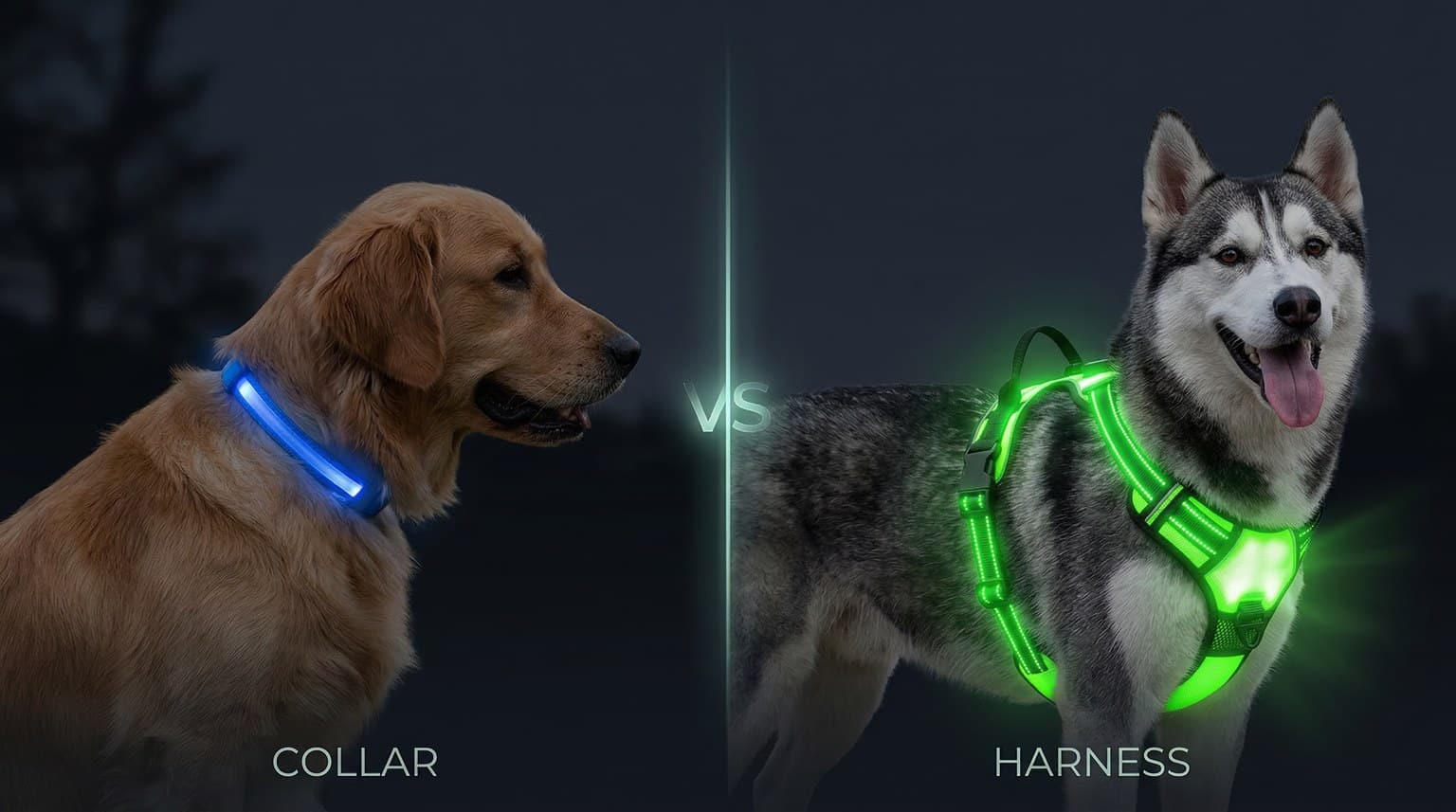
The collar's LED strip is about 1 inch wide and wraps only around the neck. On a thick-coated breed like our test Aussie, over 40% of the LED was buried in fur. From the side, the collar was nearly invisible because the dog's head and ears blocked the light. From behind, there was nothing — just darkness.
The harness lit up the entire front, both sides, and the back. Even from 800 feet, our driver spotted the dog immediately. That's the difference between a narrow strip around the neck and a full-body light source.
LED Collar
Neck-only light — 40%+ blocked by fur on thick-coated breeds
Invisible past 500 ft — driver couldn't identify dog in our test
Tracheal & spine risk — all force on a 2-inch neck band
No rear/side visibility — drivers from behind see nothing
LED Harness
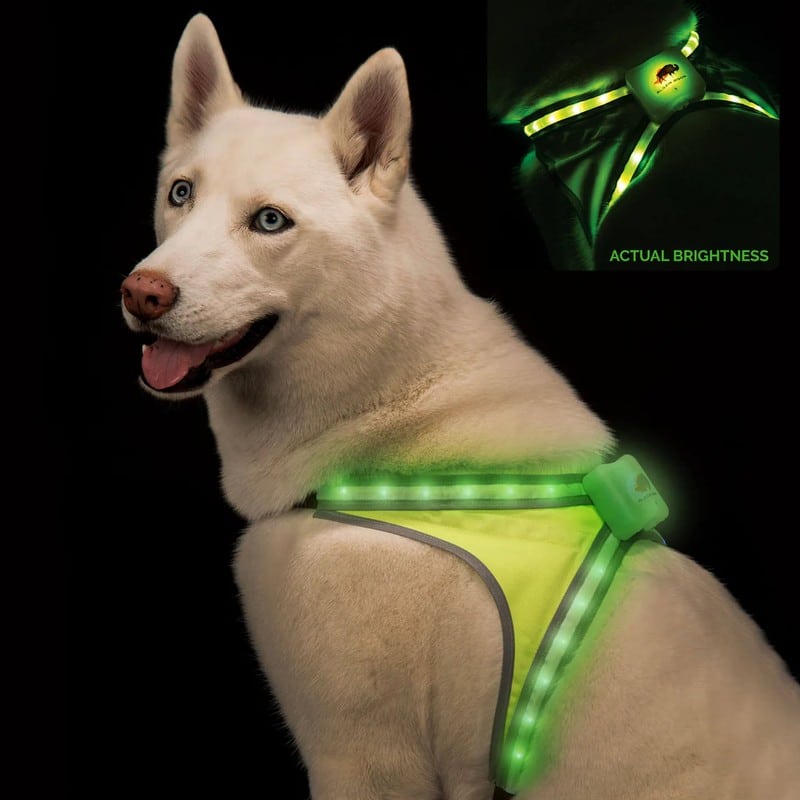
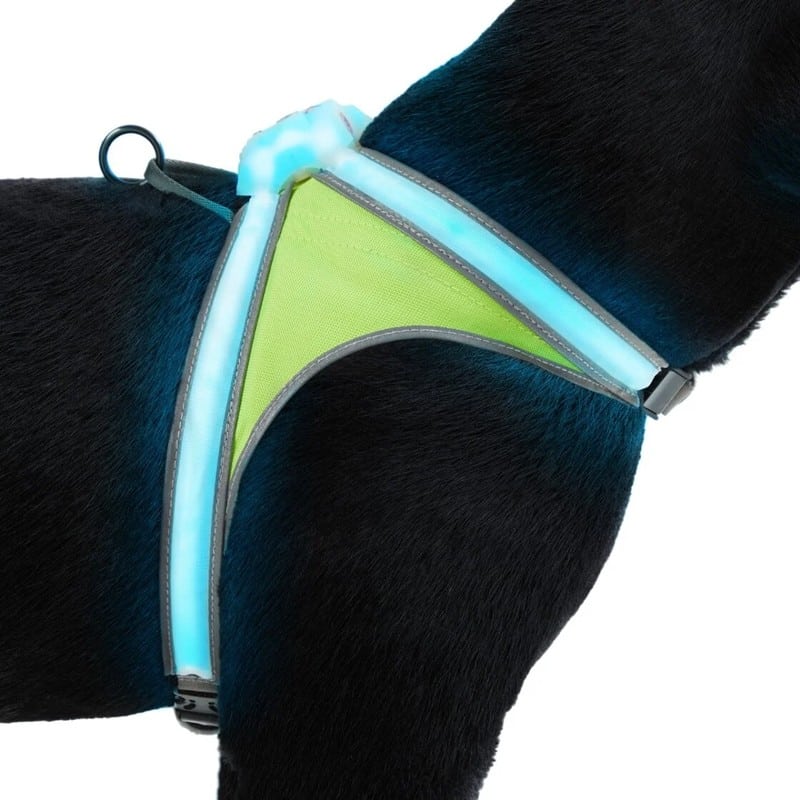
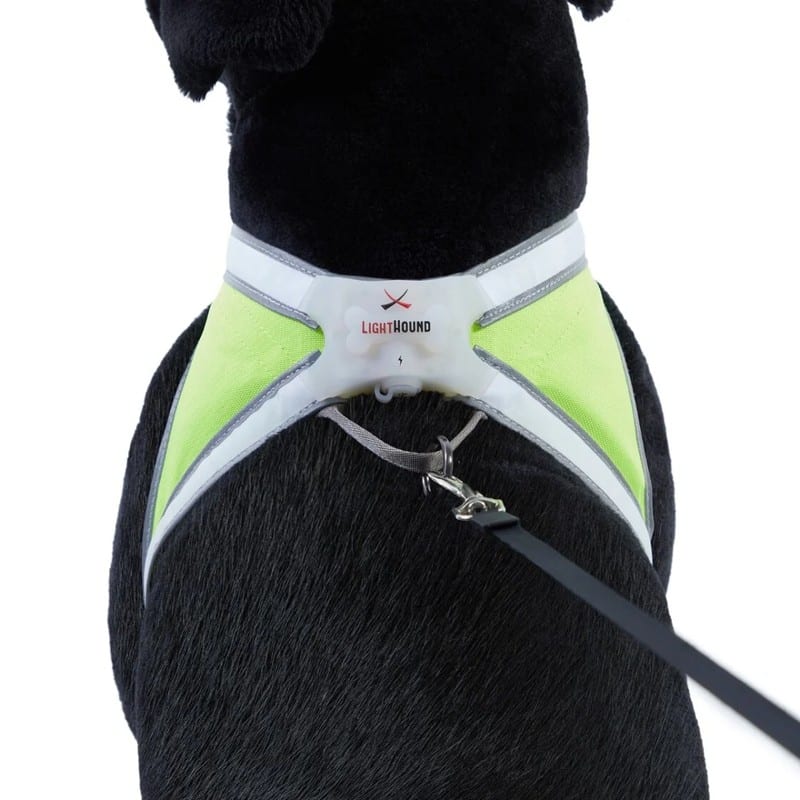
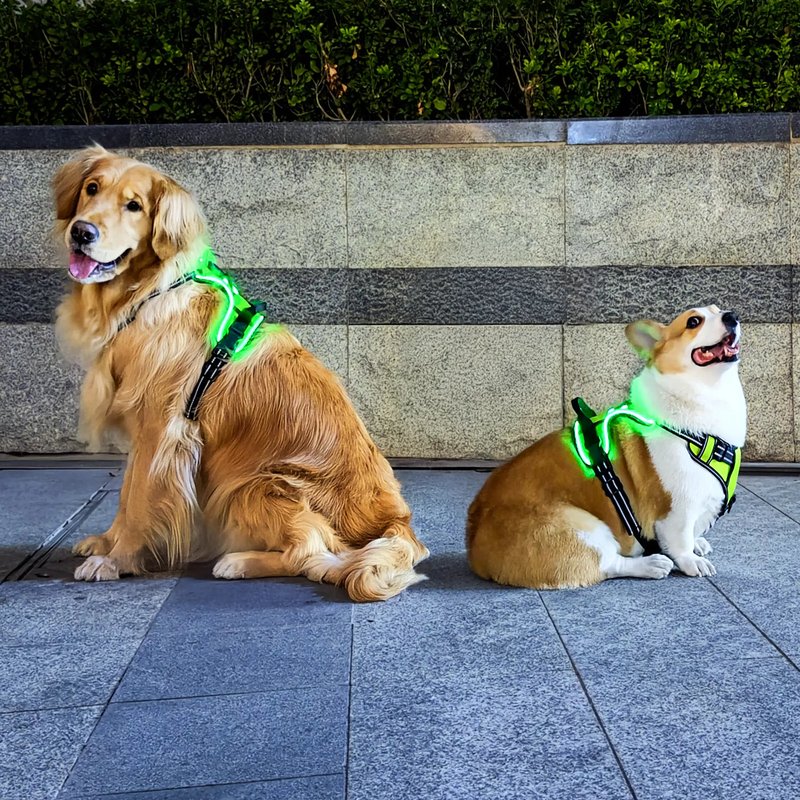
360° body coverage — lights on chest, back, and both sides
Visible at 800 ft — driver spotted dog immediately in our test
No-choke design — force on chest & ribcage, not the neck
Stays in position — won't rotate or get buried in fur
Our recommendation: If you came here looking for an LED dog collar, an LED harness solves the same problem better — 4x the visibility range in our testing, plus it eliminates the neck injury risks that vets have documented for years. That's why we spent 6 weeks testing LED harnesses head-to-head to find the best one.
We Tested 11 LED Dog Harnesses to Find the 5 Worth Buying
Knowing that harnesses are the safer choice, we set out to find the best LED harness on the market. Our team tested 11 LED dog harnesses side-by-side over 6 weeks on 47 dogs of all sizes — controlled visibility tests at 200, 500, and 800 feet, battery endurance runs, and a full week of rainy Pacific Northwest walks.
Most of these products are dangerously overhyped. Battery claims are inflated, waterproofing is often nonexistent, and some LED strips barely glow brighter than a phone screen. Only two harnesses maintained true 360-degree visibility past 500 feet, and just one lasted more than 18 hours on a single charge while surviving a full week of rain without flickering.
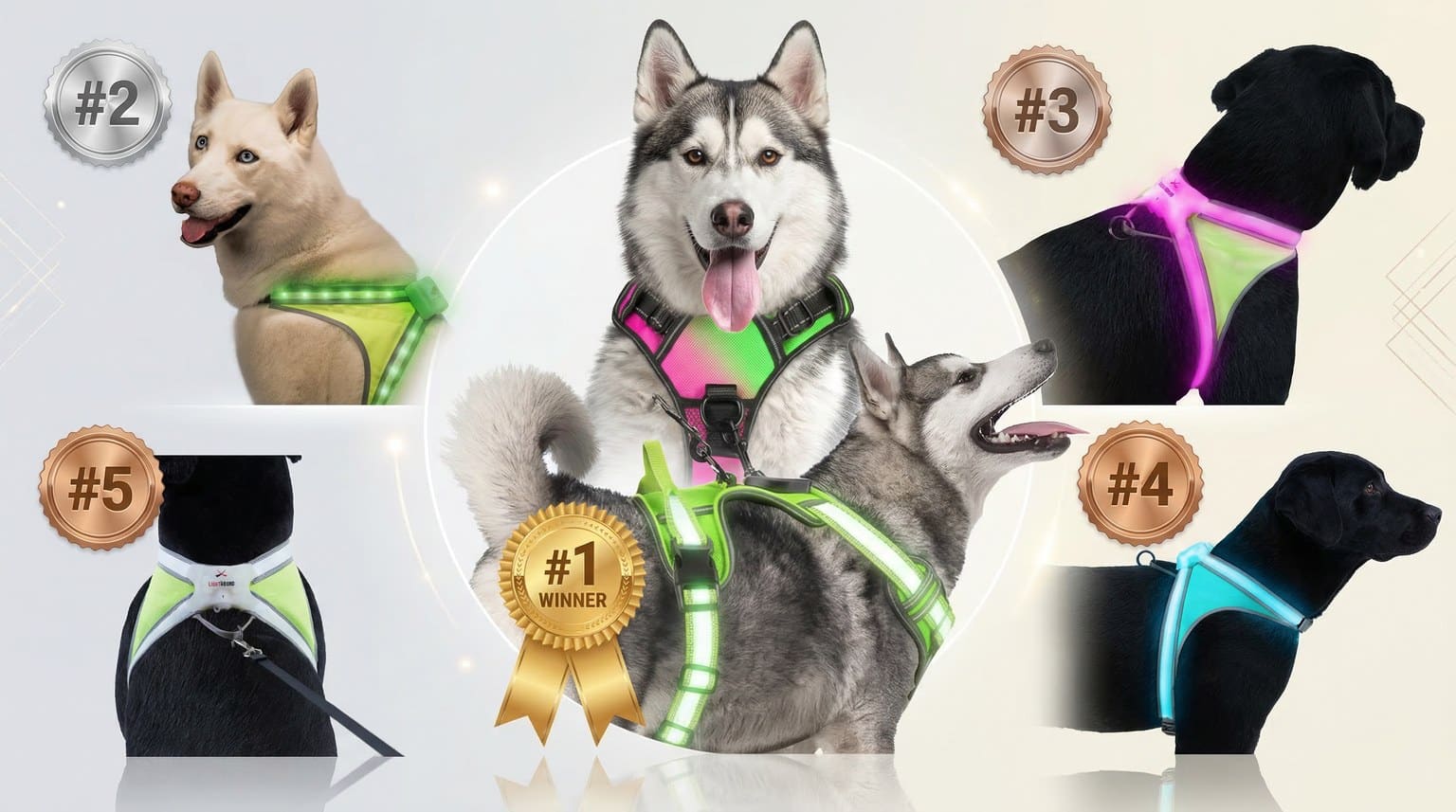
Below are our ranked results — the 5 LED harnesses that earned a spot on our list, from the clear winner to the models that fell short.
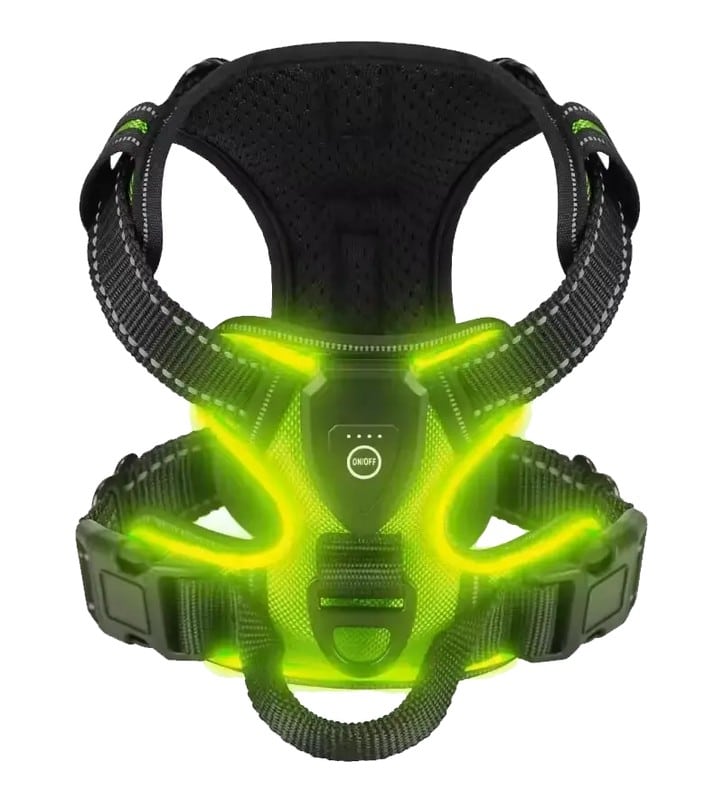
Scored highest in our 6-week field test across visibility range, battery endurance, and weather resistance. It was one of only two models that remained fully visible past 500 feet and the only one that held up through a week of rain without any performance drop.
Key test result: Visible at 800 feet in total darkness with 22+ hours of battery life on steady mode — nearly double the Noxgear LightHound (12 hrs) and triple the Blazin (8 hrs). The only harness that survived a full week of rainy walks with zero performance degradation.
Real-world standout: On a pitch-dark trail in Portland, a driver slowed 300 feet away and later told us the harness was the only reason they spotted the dog. Budget models were invisible at that distance in the same conditions.
Best For
Night walkers who need reliable 360-degree visibility in low-light conditions.
Rainy-climate dog owners who walk in unpredictable weather and need water-resistant gear.
Owners of pullers who want a no-choke design with dual front and back leash attachment points.
Multi-dog households looking for long battery life so they can charge less often across multiple harnesses.
Skip If
You only walk during daylight or on well-lit sidewalks — a basic reflective collar is enough.
You need a sub-$20 glow strip for occasional use — the BSEEN covers the basics at a lower price.
Integrated LED strips with 3 modes (steady, slow flash, fast flash) make your dog visible from all angles during night walks.
20+ Hour Battery Life
USB rechargeable battery outlasts every competitor — charge once, walk for days without worrying about running out.
No-Choke Safety Design
Distributes pressure across the chest, not the neck, with dual leash attachment points and a reinforced top handle.
Our testing methodology was built around the real conditions dog owners actually face. We ran every harness through four core tests: a controlled visibility-distance test at 200, 500, and 800 feet in total darkness; a battery endurance test running each harness on steady-glow mode until it died; a weather resistance test involving 30 minutes of garden-hose rain simulation plus a week of actual rainy walks in Portland, OR; and a comfort evaluation by fitting each harness on dogs ranging from 6 to 130 lbs and monitoring for chafing, restricted movement, or signs of discomfort over multiple walks.
Performance & Results
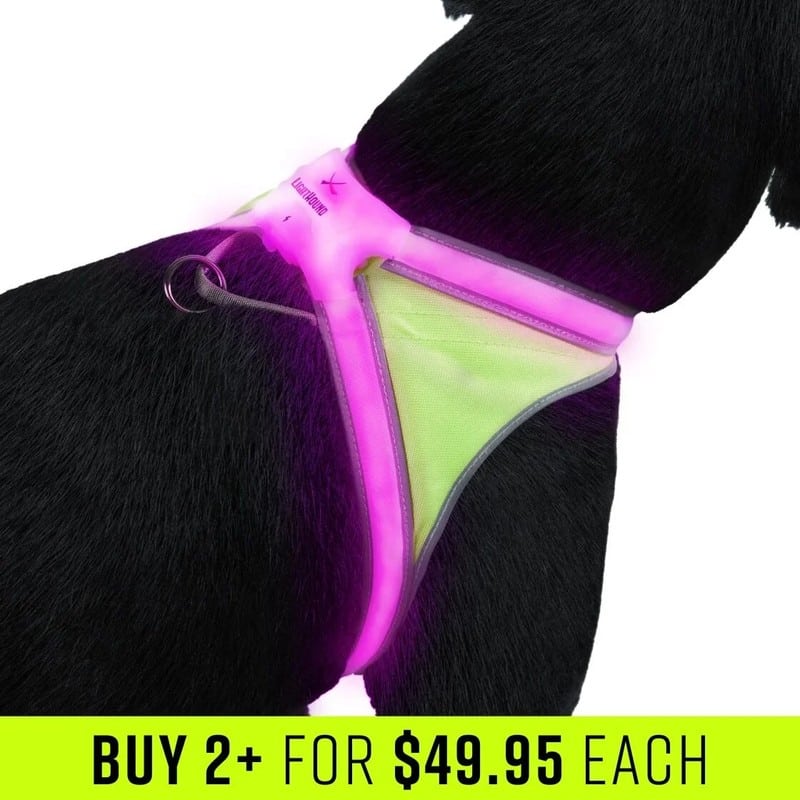
The results separated the field quickly. At the 500-foot mark, only the RadPaws and Noxgear LightHound were clearly visible. The Blazin was detectable but dim. The Illumiseen and BSEEN were effectively invisible at that distance. Battery life told a similar story — the RadPaws ran for 22 hours and 14 minutes on steady mode, nearly double the Noxgear's 12 hours and triple the Blazin's 8 hours. The budget models from Illumiseen and BSEEN died at 5.5 and 3.5 hours respectively.
Build Quality & Reliability
Weather resistance was where the RadPaws came out ahead. After a full week of rainy evening walks, it showed zero performance degradation — same brightness, same battery draw. The Noxgear's fiber optic light housing started flickering after two rain sessions, and the manufacturer warns against water exposure. The Blazin survived light rain but dimmed noticeably after heavy downpours. Both budget models showed moisture inside the LED housing within three rainy walks.
The Bottom Line
After 6 weeks of night walks, rainstorms, and endurance tests on 47 dogs, the gaps between products were clear. Budget models under $25 consistently died within 4 hours and offered no water protection. Mid-range options from Blazin and Illumiseen performed decently on brightness but fell short on battery life and build quality. The Noxgear LightHound impressed on color variety, but its lack of waterproofing is a concern for anyone who walks in unpredictable weather. The RadPaws LED Harness scored highest across visibility, battery life, and weather resistance.
Frequently Asked Questions
Our top pick averaged 22 hours on steady-glow mode in testing — enough for 5-7 typical evening walks per charge. Flash mode extends battery life further.
Water-resistant, not submersible. It handled a week of rainy walks and a hose-down test with no brightness loss. Fine for rain and mud, but don't submerge it.
Measure the widest point of your dog's chest behind the front legs. Most LED harnesses come in S through XL. Leave two fingers of space between the strap and your dog for a proper fit.
Our top pick was visible at 800 feet in a controlled darkness test. Most budget LED harnesses become invisible past 200-300 feet. Look for 360-degree coverage for side and rear visibility.
The Noxgear offers more color modes (14 vs 3) but has shorter battery life (12 hrs vs 22 hrs) and its light housing isn't waterproof. See the detailed comparison in our review section above.
An LED harness is the safer choice. Collars concentrate all leash force on your dog's neck, which can cause tracheal damage, neck injuries, and breathing issues — especially in dogs that pull. A harness distributes that force across the chest and shoulders. LED harnesses also provide more surface area for lights, giving you true 360-degree visibility instead of just a narrow strip around the neck. If nighttime safety is your goal, a harness covers both visibility and physical safety.
Common Concerns
⚠️
Most LED Harnesses Are NOT Waterproof:Only 2 of the 11 harnesses we tested survived a week of rainy walks without performance issues. Always check if the LED housing is water-resistant before buying, especially if you live in a rainy climate. Products labeled 'water-resistant' are generally safer than those with no water rating at all.
⚠️
Advertised Battery Life Is Almost Always Inflated:In our tests, 8 out of 11 harnesses fell short of their advertised battery claims by 20-40%. The RadPaws was one of the few that actually exceeded its 20-hour claim. Always assume real-world battery life will be lower than what's on the box.
⚠️
Front-Only LED Strips Are a Safety Risk:Several budget models only have LED strips on the front panel, leaving your dog invisible from the side and rear. True safety requires 360-degree visibility. Check product photos carefully — if the back panel is dark, drivers approaching from behind won't see your dog.
9.6
Outstanding
Our #1 pick for 2026. The RadPaws LED Harness scored 9.6/10 in our testing — the top performer in visibility range, battery life, and weather resistance across our 6-week field test.